



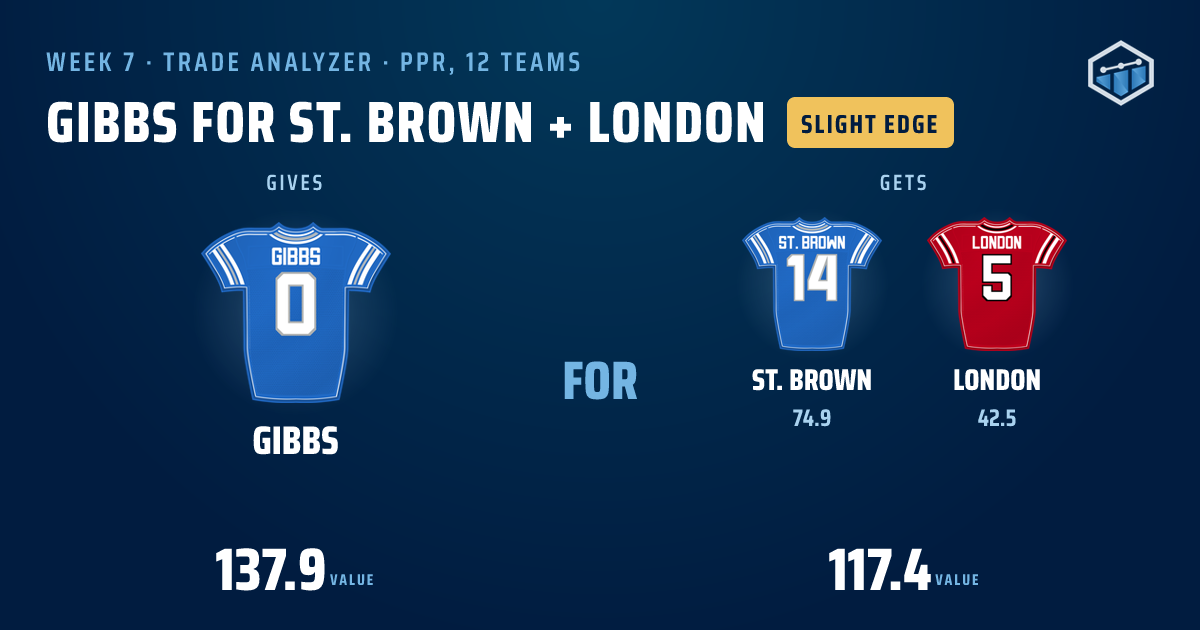
Trade offers start landing about now, and most come with a sales pitch. The new Trade Analyzer gives you a second opinion in seconds: is it fair, and does it help your team?
The Trade Analyzer
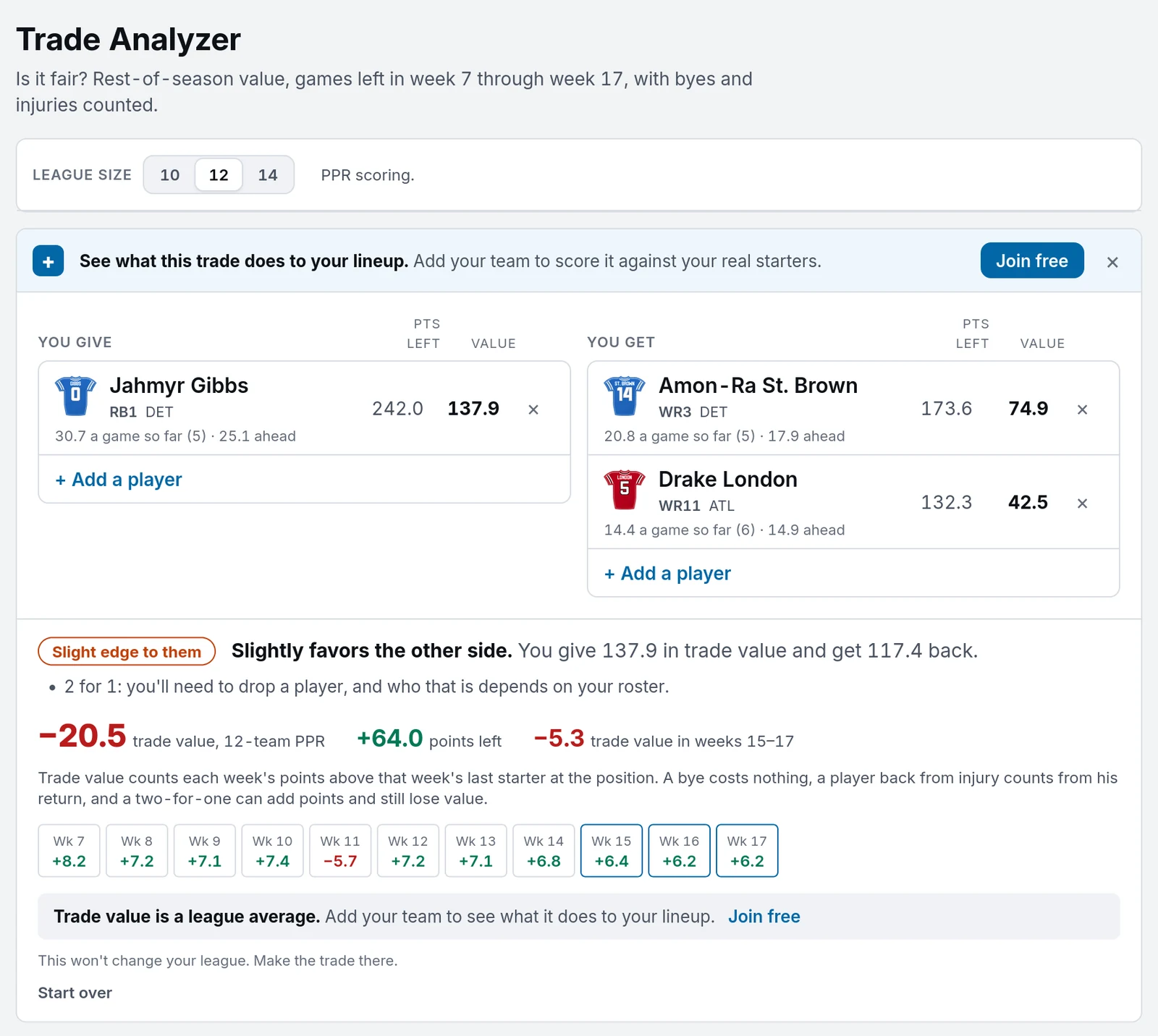
Pick who you'd give and who you'd get, up to five a side. You get a plain call (Fair, Slight edge, Clear edge or One-sided) and each side's trade value. It's under Research, and you don't need an account.
Trade value counts a player's projected points in each week left, above the last starter at his position in your league size (10, 12 or 14 teams). Weeks he'd spend on your bench add nothing. Byes and injuries are already counted, so a player on IR is valued from the week he's due back. The scoring switch in the header rescores everything.
That's why more points doesn't always mean a better trade. On week 7's numbers, Amon-Ra St. Brown and Drake London had 64 more PPR points left between them than Jahmyr Gibbs. But Gibbs clears the last starting running back by far more each week than they clear the last starting receivers, so he was worth 137.9 to their 117.4. The side getting Gibbs comes out ahead, and the side getting two has to drop a player to make room.
Weigh it for your team
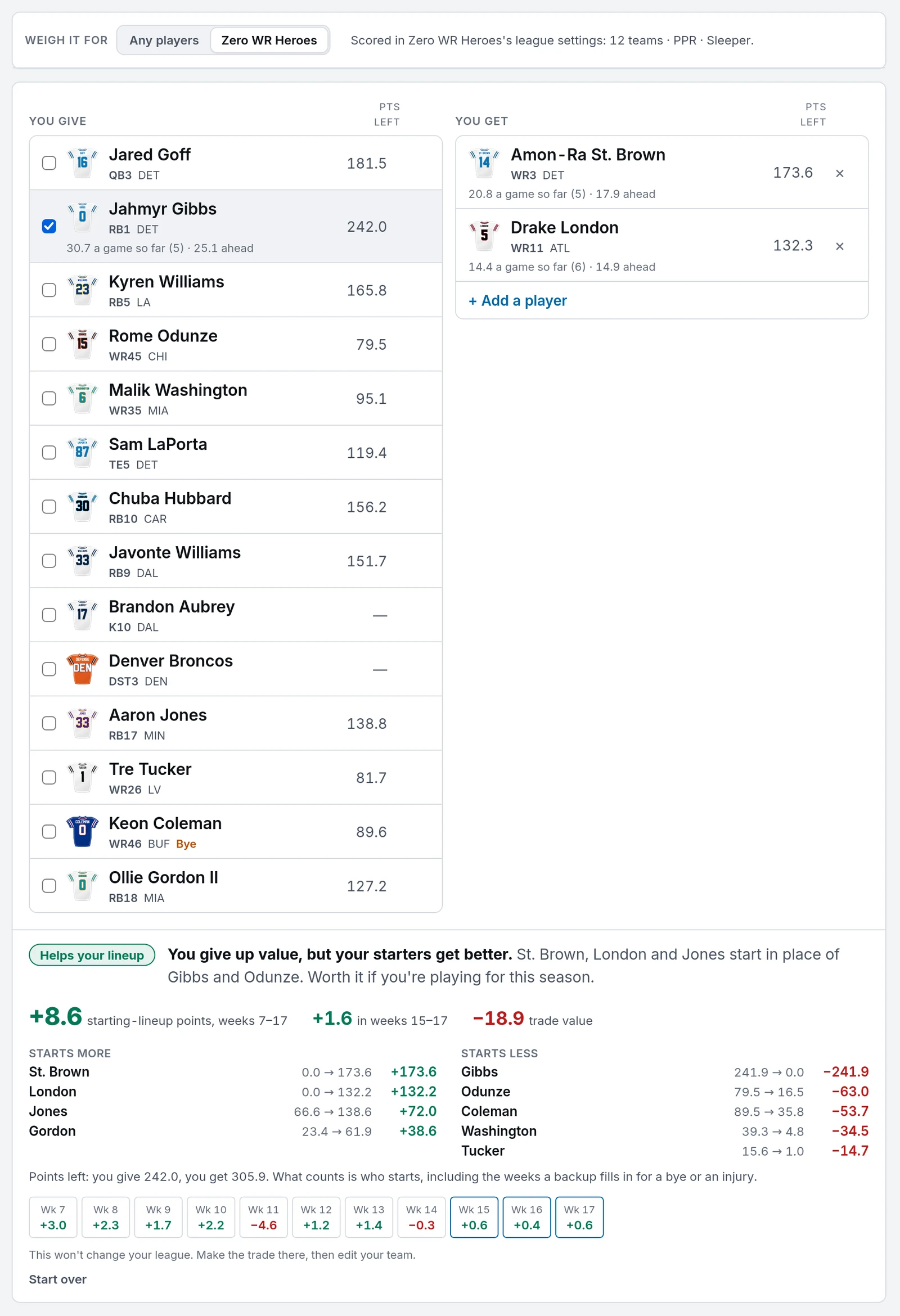
If you've added a team under My teams, choose it under Weigh it for. You give from your real roster, and the verdict becomes your best starting lineup in every week left, with and without the trade, in your league's own settings. It shows who starts more and who starts less. In a two-for-one it drops whoever adds least, and in a one-for-two it fills the open spot with a likely waiver pickup.
Here's the same Gibbs trade, weighed for a team that drafted running backs early and is thin at receiver. It still gives up 18.9 in trade value, but St. Brown, London and Aaron Jones start in place of Gibbs and Rome Odunze, and the lineup gains 8.6 points over the rest of the season. A trade that loses on value can still be the right one if you're playing for this season, and a fair one can still weaken your lineup. League settings count too: in a superflex league, quarterbacks are worth far more.
Trade advice on any team page now opens the analyzer with that team chosen.
Share it
Every trade is a link. Paste it in your league chat and it unfurls as a card with the call and both sides' values. The card shows the league-wide view, since nobody else can see your team.
How we tested it
We ran simulated trades through a full league and checked each call against what the trade did to both lineups, then tuned the analyzer until its calls held up. The team view is the most accurate, because it sees your actual roster.
Starters coming back from IR
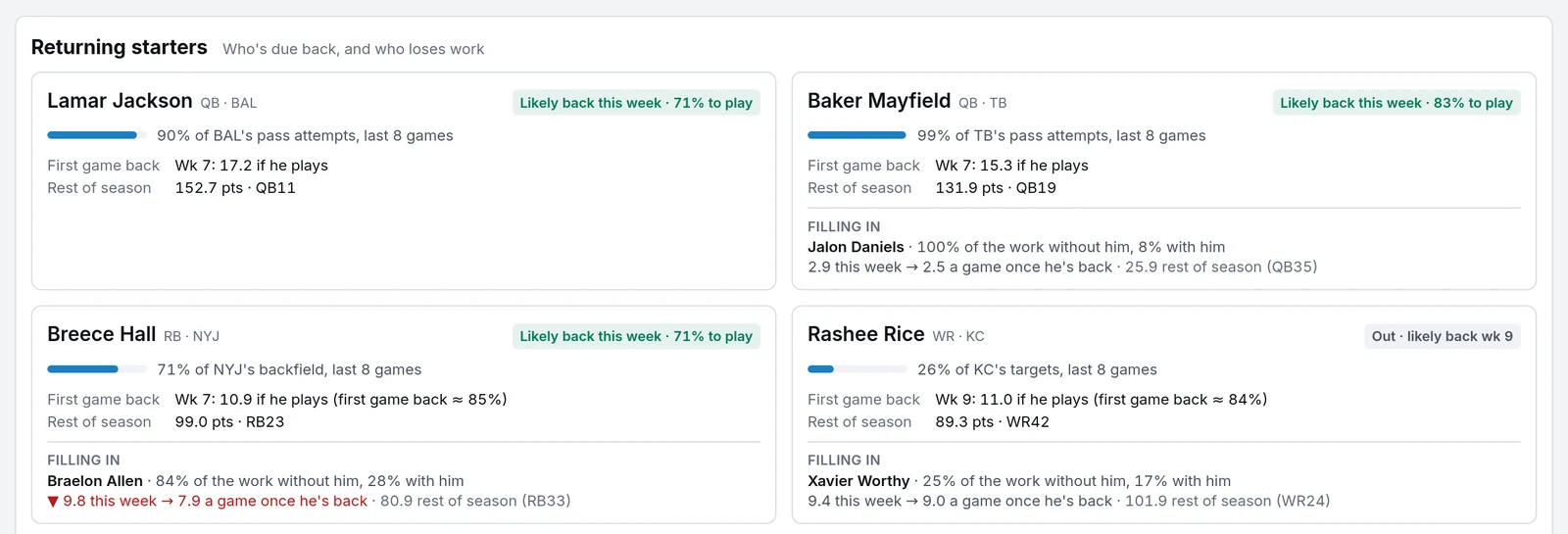
Projections now handle a starter coming back from IR or another reserve list. His first game back is projected below his usual form, and the teammates who filled in give some of their work back. His player page says so too.
Trends has a new Returning starters section for quarterbacks, running backs, receivers and tight ends: who's due back and when, what he's projected for, and which fill-ins lose work.
A player out for the season now stays out of every rest-of-season number, so a season-ending injury can't inflate a trade.
If a trade call looks wrong, tell us.